
We are living in an exciting time.
AI can write.
AI can draw.
AI can create images.
AI can generate ideas.
AI can answer questions.
AI can even help us solve problems.
Because of this, AI can sometimes feel like something completely different from every tool we have used before.
Something powerful.
Something mysterious.
Something that may change everything.
But perhaps we should look at it differently.
Perhaps AI is simply another tool.
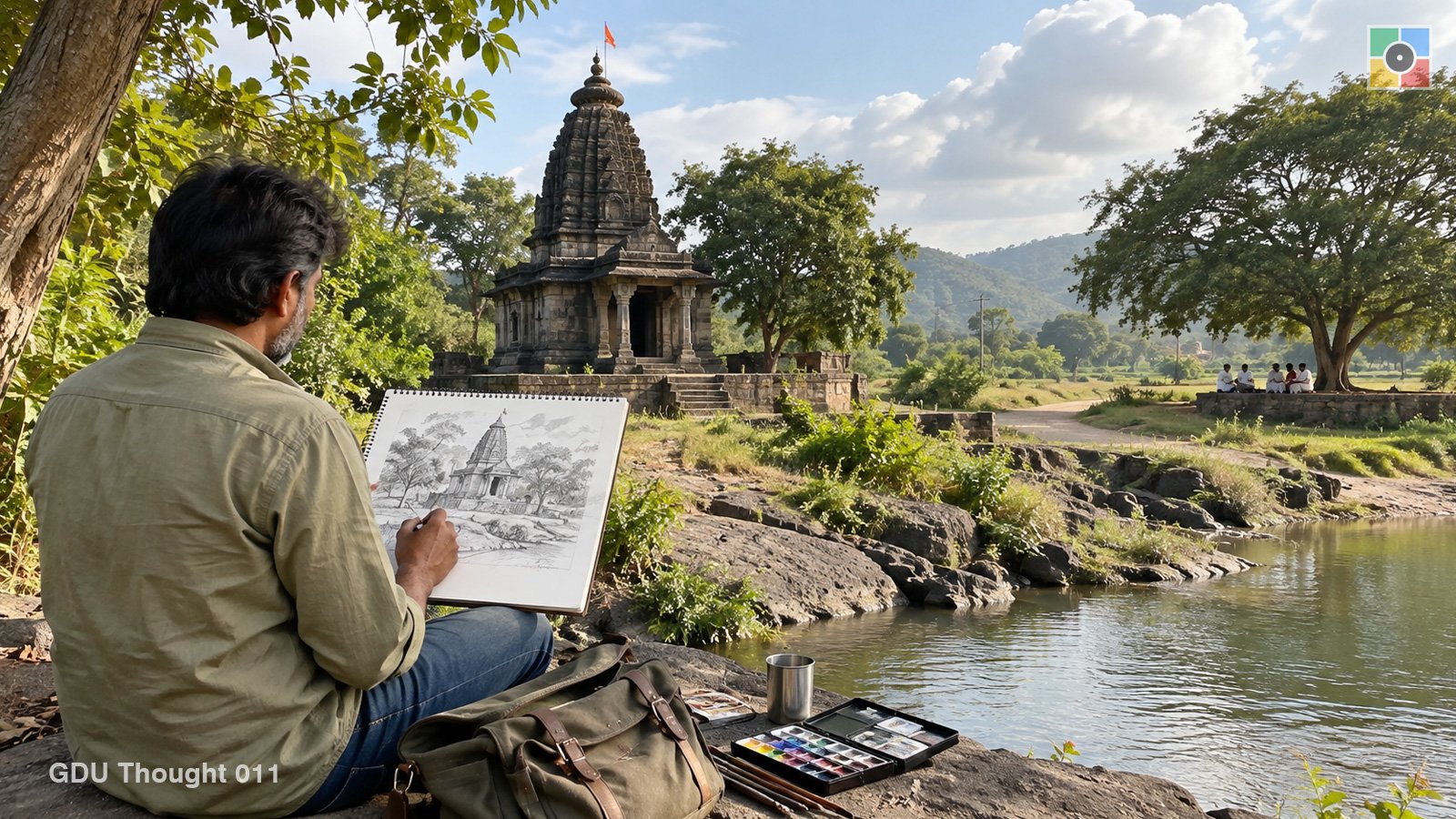
Like a pencil.
Think About a Pencil
Imagine giving a pencil to someone who has never learned to draw.
Will the pencil make them a good artist?
No.
The pencil can make a line.
But it cannot decide what the line should mean.
It cannot decide where the line should begin.
It cannot decide how long the line should be.
It cannot decide what the drawing is trying to communicate.
Those decisions come from the person holding the pencil.
The pencil is only a tool.
Now give the same pencil to an experienced artist.
Something different happens.
The artist knows what to look for.
They understand proportion.
They understand shape.
They understand light.
They understand composition.
They know when a line is necessary.
They also know when not to draw a line.
The pencil has not changed.
The person using it has changed.
AI Works in a Similar Way
AI can be extremely powerful.
But power in a tool does not automatically create understanding in the person using it.
Give AI to someone who understands their subject, and it can become incredibly useful.
Give the same AI to someone who does not understand the subject, and it can produce a lot of information without necessarily producing understanding.
This is an important difference.
A person who understands graphic design can look at an AI-generated visual and ask:
Is the hierarchy clear?
Is the composition balanced?
Does the typography support the message?
Is the color appropriate?
Does this visual communicate to the intended audience?
Is something unnecessary?
Is the design solving the actual problem?
AI may help create the visual.
But the designer still has to judge the visual.
That judgment does not come from the tool.
It comes from understanding.
The Pencil Never Designed the Drawing
A pencil can create thousands of different drawings.
But the pencil does not know which drawing should be created.
The person does.
A camera can capture thousands of photographs.
But the camera does not know which moment matters.
The photographer does.
A computer can process millions of calculations.
But it does not automatically know which problem is worth solving.
The person does.
And AI is similar.
It can generate possibilities.
It can help us explore.
It can help us create.
It can help us learn.
But we still need to know what we are trying to do.
Powerful Tools Are Not New
Sometimes we think AI is the first powerful tool humanity has ever created.
It is not.
Think about the tools designers already use.
A pencil.
A brush.
A camera.
A scanner.
A printing press.
A computer.
Photoshop.
CorelDRAW.
Illustrator.
A graphic designer has always worked with tools.
And tools have always changed.
The pencil did not disappear when the computer arrived.
The camera did not make composition unnecessary.
Software did not make design principles unnecessary.
Technology changed the way we worked.
But the need to think did not disappear.
AI is another step in that same story.
When the Tool Becomes the Focus
There is a danger whenever a new tool becomes exciting.
We start talking about the tool instead of the work.
We start asking:
Which AI tool should I learn?
Which model is better?
Which prompt should I use?
Which software can generate this?
Which new feature has arrived?
These questions can be useful.
But they can also distract us.
Imagine a graphic designer spending months learning every new AI feature but never improving their understanding of typography.
They may become very good at operating a powerful tool.
But are they becoming a better designer?
That is the question.
The tool should serve the skill.
The skill should not become a servant of the tool.
A Pencil Does Not Make You an Artist
Nobody says:
“I know how to use a pencil, therefore I am an artist.”
We understand that using the tool is only one part of the process.
We need observation.
We need practice.
We need understanding.
We need imagination.
We need judgment.
We need experience.
The same principle applies to AI.
Knowing how to write a prompt is useful.
Knowing how to generate an image is useful.
Knowing how to use an AI application is useful.
But these things alone do not make someone a designer.
They are abilities for using a tool.
The deeper ability is knowing what to do with the tool.
AI Can Make a Good Designer Better
Now consider the other side.
A tool can be incredibly valuable when the person using it understands the subject.
A designer can use AI to explore ideas.
They can ask for alternatives.
They can test different approaches.
They can study examples.
They can ask questions.
They can get another perspective.
They can experiment much faster.
They can use AI to learn something they do not yet understand.
In this way, AI can become a powerful extension of the designer’s thinking.
Not a replacement for thinking.
An extension of thinking.
That distinction matters.
Your Knowledge Travels With You
There is another reason to think of AI as a tool.
Tools change.
A pencil may be replaced by a stylus.
A camera may become digital.
Software versions change.
New AI models appear.
New interfaces arrive.
New features come and go.
But your understanding can travel with you.
If you understand typography, you can work with new typography tools.
If you understand composition, you can adapt to new image technologies.
If you understand visual communication, you can work across new platforms.
If you understand design principles, you can learn new software.
The tool may change.
Your understanding remains useful.
This is exactly why ARTEK places principles before software and technology. Technology is temporary, while principles can remain useful for a very long time.
Don’t Be Afraid of the New Tool
There is also no reason to fear AI simply because it is powerful.
A pencil did not destroy drawing.
A camera did not destroy photography.
The computer did not destroy graphic design.
Each new technology changed the way people worked.
AI will also change the way we work.
Some tasks will become easier.
Some tasks will become faster.
Some tasks will disappear.
New tasks will appear.
But this does not mean that human thinking has become unnecessary.
It means that human thinking becomes even more important.
Because when a tool can produce many possibilities, someone still needs to decide which possibility is worth keeping.
The Person Behind the Tool Matters
Imagine two designers using exactly the same AI tool.
They have the same software.
The same model.
The same features.
The same number of possibilities.
Will they necessarily produce the same quality of work?
No.
Because the tool is only one part of the equation.
Their observation may be different.
Their experience may be different.
Their understanding may be different.
Their purpose may be different.
Their judgment may be different.
Their ability to communicate may be different.
The tool is the same.
The thinker is different.
That is where human value remains.
So, What Should You Learn?
Learn your subject.
Learn how to think about problems.
Learn the principles.
Learn how to observe.
Learn how to make decisions.
Learn how to practice.
Learn how to evaluate your own work.
And yes…
Learn how to use AI.
But learn AI as a tool for your subject.
Not as a replacement for your subject.
If you are a graphic designer, learn graphic design.
If you are a photographer, learn photography.
If you are a writer, learn writing.
If you are a teacher, learn teaching.
If you are a business owner, learn your business.
Then pick up AI.
Just like you would pick up a pencil.
AI is Another Pencil
Perhaps this is a simpler way to think about the future.
AI is powerful.
AI is new.
AI is changing rapidly.
But the basic relationship has not changed.
A tool is still a tool.
The person using it still matters.
The purpose still matters.
The understanding still matters.
The judgment still matters.
The thinking still matters.
A pencil can help you draw.
A camera can help you capture.
A computer can help you create.
AI can help you explore, create, learn and solve.
But none of these tools can decide what is meaningful for you.
That responsibility remains human.
One Memorable Quote
AI is another pencil.
The tool can help you create.
But you still have to know what to create.
Practical Takeaway
The next time you use an AI tool, don’t ask only:
“What can AI do?”
Also ask:
“What do I want to do with it?”
Learn your subject.
Understand the problem.
Think about the purpose.
Then use AI.
Experiment with it.
Question it.
Challenge its answers.
Use it to explore possibilities.
And use your own understanding to decide what is worth keeping.
One Thought to Remember
The future will certainly bring more powerful tools.
We will see AI become faster.
Smarter.
More capable.
More integrated into our everyday work.
But powerful tools do not remove the need for capable people.
They increase the value of people who know how to use them wisely.
So don’t spend all your time asking which tool is the most powerful.
Ask a more important question:
How can I become more capable?
Because the best tool in your hands is still limited by what you understand.
AI is another pencil.
And the future still needs someone who knows what to draw.
Because Graphic Design is not just about software or AI.
It is about thinking.
And thinking is unlimited.