
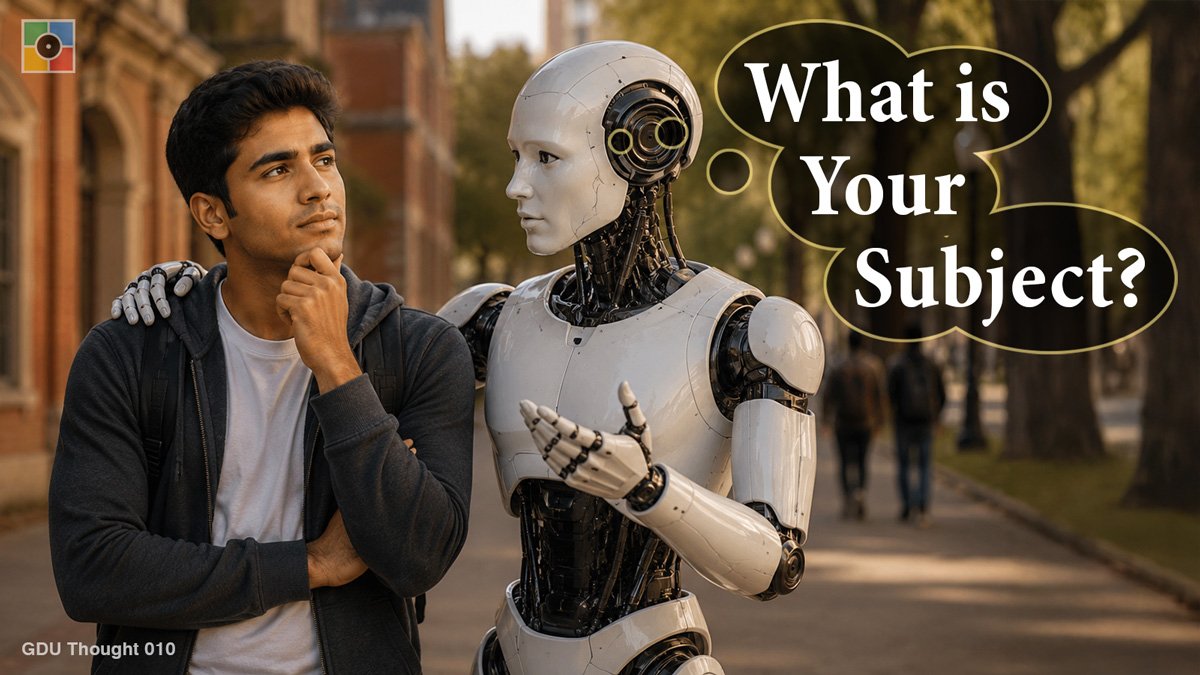
We are living in a time when learning has become easier than ever.
You can learn almost anything.
You can search for information.
You can watch a video.
You can take an online course.
You can read a book.
And now, you can ask AI.
AI can explain a difficult topic in seconds.
It can give you examples.
It can answer questions.
It can create exercises.
It can even act like a personal learning assistant.
This is a wonderful opportunity.
But there is one important question we should ask.
What are you actually trying to learn?
Do Not Learn AI Instead of Your Subject
AI is becoming an important part of learning.
So naturally, many people are asking:
“How do I learn AI?”
“What are the best AI tools?”
“How do I write better prompts?”
“How can AI make my work faster?”
These are useful questions.
But there is a bigger question.
What is your subject?
If you are a graphic designer, your subject is not AI.
Your subject is graphic design.
AI is a tool that can help you learn graphic design better.
If you are a photographer, your subject is photography.
If you are a writer, your subject is writing.
If you are a teacher, your subject is teaching.
If you are a business owner, your subject is your business.
AI can help you learn all of these.
But AI itself should not become the destination.
Your subject comes first.
The Tool is Not the Subject
Imagine a person who wants to become a better graphic designer.
They start learning AI image generators.
Then they learn AI writing tools.
Then they learn prompting.
Then they discover another AI tool.
Then another.
Soon, they know how to generate hundreds of images.
But they still do not understand typography.
They still struggle with composition.
They do not know how to create visual hierarchy.
They do not understand why one design communicates clearly and another does not.
They have learned many tools.
But they have not learned their subject deeply.
This is an important distinction.
Knowing how to use a tool is not the same as understanding what you are doing with it.
A Calculator Does Not Teach Mathematics
Think about a calculator.
A calculator can perform a difficult calculation very quickly.
But does using a calculator make you understand mathematics?
Not necessarily.
You still need to understand what calculation is required.
You need to know which numbers matter.
You need to know whether the answer makes sense.
The calculator gives you speed.
Understanding gives you direction.
AI is similar.
AI can give you an answer very quickly.
But you still need enough understanding to ask the right question, evaluate the answer, and use it correctly.
That is why learning your subject remains important.
AI Can Become a Better Teacher When You Already Care About Learning
There is another way to look at AI.
Instead of asking AI to do your work…
Ask it to help you understand your work.
Suppose you are learning typography.
You could ask:
“Give me ten font combinations.”
That may give you useful answers.
But you could ask better questions.
“Why does this font combination work?”
“What is wrong with my typography?”
“Explain visual hierarchy in simple language.”
“Give me three examples of good and bad hierarchy.”
“Ask me questions to test whether I understand typography.”
“Give me an exercise and evaluate my solution.”
Now something different is happening.
You are not simply collecting answers.
You are learning your subject.
AI has become a learning partner.
Understanding Changes the Way You Use AI
The quality of your AI interaction depends greatly on what you already understand.
A beginner may ask:
“Make me a good poster.”
Someone who understands design may ask:
“I need a poster for this audience and purpose. The main message must be understood within a few seconds. How would you approach the hierarchy?”
The second person is not necessarily better at prompting.
They simply understand the problem better.
Their subject knowledge helps them communicate with the tool.
This is why learning your subject becomes even more important in the age of AI.
The better you understand the subject, the better you can use AI.
AI Can Give You Many Answers. You Still Need Judgment.
AI can give you ten ideas.
It can give you twenty.
It can give you a hundred.
But which one is good?
Which one is useful?
Which one is correct?
Which one suits the situation?
Which one should you reject?
AI can help you explore the options.
But judgment comes from understanding.
Consider a graphic designer using AI to generate a visual.
The AI may create a beautiful image.
But the designer still needs to ask:
Does it communicate the message?
Does it suit the audience?
Is the composition appropriate?
Does it fit the brand?
Is the visual helping the design or distracting from it?
These are design decisions.
And design decisions require understanding.
Learn Principles. Then Use AI to Explore Them.
One of the strongest ways to learn is to understand principles.
Suppose you are learning color.
You can ask AI to suggest color combinations.
That is useful.
But if you understand contrast, harmony, temperature, emphasis and visual attention, you can judge those combinations yourself.
The same applies to typography.
The same applies to composition.
The same applies to photography.
The same applies to writing.
The same applies to almost every subject.
A tool can show you possibilities.
Principles help you understand those possibilities.
This is why ARTEK’s learning philosophy places principles before software and technology. Technology changes, but principles can remain useful for a very long time.
Do Not Let AI Become Your Crutch
There is also a danger.
If you use AI for every small decision, you may slowly become dependent on it.
You may stop trying to understand.
You may stop experimenting.
You may stop remembering.
You may stop asking yourself:
“Why?”
You may simply ask:
“What should I do?”
And wait for the answer.
That is not the kind of learning we want.
The purpose of AI should not be to make you dependent on AI.
It should help you become more capable and more independent.
This is an important part of ARTEK’s AI philosophy. AI should build independence, not dependence.
Learn First. Then Ask AI Better Questions.
Imagine you are learning something completely new.
You do not need to become an expert before using AI.
You can use AI from the beginning.
But use it differently.
First, try to understand the subject.
Read.
Observe.
Experiment.
Make mistakes.
Ask questions.
Then use AI to go deeper.
Ask:
“Why did this happen?”
“Where did I go wrong?”
“Can you explain this another way?”
“What principle am I missing?”
“Give me another example.”
“Challenge my understanding.”
“What would happen if I changed this?”
“Test me.”
These questions turn AI from an answer machine into a learning partner.
A Designer Who Understands Can Adapt
Think about the future of graphic design.
Software will change.
AI tools will change.
Workflows will change.
New formats will appear.
Some tasks will become automated.
New tasks will emerge.
But a designer who understands design principles can keep adapting.
If you understand typography, you can learn new typography tools.
If you understand composition, you can work with new image technologies.
If you understand visual communication, you can adapt to new platforms.
If you understand the purpose of design, you can work even when the tools change.
The technology may change.
Your understanding travels with you.
That is a much stronger foundation than simply knowing where to click.
The Best Use of AI May Be Learning What You Already Do
There is an interesting possibility here.
We often think AI will help us learn new things.
But it can also help us understand the things we already do.
A designer can ask AI to analyze a design.
A teacher can ask AI to challenge a lesson plan.
A writer can ask AI to identify weaknesses in an article.
A photographer can ask questions about composition.
A student can ask AI to test their understanding.
In each case, the person remains at the center.
AI provides another perspective.
And sometimes, another perspective is exactly what learning needs.
Your Subject Should Remain at the Center
This is perhaps the most important idea.
Do not let the excitement around AI make you forget what you are trying to learn.
If you are learning graphic design, learn graphic design.
If you are learning photography, learn photography.
If you are learning business, learn business.
If you are learning writing, learn writing.
Then bring AI into that learning process.
Use it to explain.
Use it to question.
Use it to compare.
Use it to practice.
Use it to challenge your thinking.
Use it to explore.
Use it to get feedback.
But keep your subject at the center.
AI should strengthen your learning, not replace it.
One Memorable Quote
Learn your subject first.
Then use AI to learn it better.
Practical Takeaway
The next time you start learning something new, try this simple approach:
Learn the subject.
Understand the basics.
Observe how things work.
Practise them yourself.
Make mistakes.
Ask questions.
Then use AI to go deeper.
Ask it to explain.
Ask it to challenge you.
Ask it to give examples.
Ask it to find weaknesses in your understanding.
Ask it to create exercises.
Ask it to test you.
And most importantly…
Do not ask AI only for answers. Ask it to help you understand.
One Thought to Remember
AI is changing the way we learn.
That is exciting.
But the most important thing has not changed.
You still need to understand something before you can use it well.
You still need to practise.
You still need to make decisions.
You still need to develop judgment.
You still need to think.
So don’t make AI your subject when your real goal is to learn something else.
Learn your subject.
Use AI to learn it better.
Because the future does not need people who only know how to use powerful tools.
It needs people who understand what they are doing with those tools.
And that is where real learning begins.
Thank you for reading this GDU Thought.
If this thought made you think differently, you’ll find many more like this in the GDU Thoughts series.
Because Graphic Design is not just about software or AI.
It is about thinking.
And thinking is unlimited.