
Learning has changed.
Information is everywhere.
You can search for almost anything.
You can watch a tutorial.
You can read an article.
You can ask AI.
You can find an answer in seconds.
But there is an interesting problem.
Having more answers does not always make us better learners.
Sometimes, the quality of our learning depends on something that comes before the answer.
The question.
A good question can open a door.
A poor question can lead us in the wrong direction.
That is why one of the most important learning skills is not knowing more.
It is learning how to ask better questions.
Answers Are Easy to Find
Imagine a student learning graphic design.
The student wants to create a poster.
They open an AI tool and ask:
“Give me a poster design.”
The AI produces several ideas.
The student chooses one.
The work is done.
Or is it?
What if the student asked a different question?
“What should this poster communicate?”
Then another:
“Who is the audience?”
Then:
“What should the viewer notice first?”
Then:
“What information is most important?”
Then:
“What should I remove?”
Now the student is doing something different.
The student is not simply asking for a design.
The student is trying to understand the problem.
That difference is important.
A Question Can Be More Valuable Than an Answer
We often think that learning means collecting answers.
But real learning often begins when we discover better questions.
A beginner may ask:
“Which font should I use?”
A better question may be:
“What should this typography communicate?”
A beginner may ask:
“Which color looks good?”
A better question may be:
“What should the color make the viewer feel?”
A beginner may ask:
“How do I make this logo?”
A better question may be:
“What problem should this logo solve?”
The second question changes the direction of learning.
It moves us from how to why.
And why often leads us to understanding.
The Question Behind the Question
Sometimes the question we ask is not the real question.
A student may ask:
“How can I make my design look professional?”
That sounds like a good question.
But what does “professional” actually mean?
Does it mean beautiful?
Simple?
Modern?
Clear?
Suitable for the audience?
Technically correct?
Effective?
Now we have discovered another question:
“What makes a design effective?”
And behind that question may be another:
“What is this design supposed to achieve?”
One question leads to another.
This is not confusion.
This is learning.
A good learner does not always rush toward the first answer.
A good learner is willing to go deeper.
AI Makes This Even More Important
AI has changed the situation.
Earlier, finding information could take time.
Today, AI can give us an answer almost immediately.
It can explain.
It can summarize.
It can generate examples.
It can suggest ideas.
It can compare possibilities.
It can even ask us questions.
But there is still one important responsibility.
We have to decide what we are trying to understand.
AI can respond to our question.
But the quality of the learning often depends on the question we give it.
This connects directly with an idea we explored in earlier GDU Thoughts:
AI is a learning partner.
It can help us explore.
But it should not replace our thinking.
The better we understand our subject, the better questions we can ask.
And the better questions we ask, the more useful AI can become.
The Beginner Wants the Answer
There is nothing wrong with wanting an answer.
Every learner needs answers.
The problem begins when we stop at the answer.
Imagine two students learning Photoshop.
Student A asks:
“How do I remove this object?”
Student B asks:
“Why should I remove this object?”
The first student learns a technique.
The second student may learn a design decision.
Both questions are useful.
But they produce different kinds of learning.
One teaches the hand.
The other teaches the mind.
A strong designer needs both.
Better Questions Create Better Understanding
Consider a simple design problem.
You are creating a social media advertisement.
You could ask:
“What size should I make it?”
That is a technical question.
You could then ask:
“Which software should I use?”
Another technical question.
But you could also ask:
“Who will see this?”
“What do I want them to understand?”
“What should they notice first?”
“What action should they take?”
“What information can be removed?”
Now you are thinking about communication.
That is where graphic design begins to become more than software operation.
Design is not only about making something.
It is about making something for a reason.
A Better Question Can Save Hours
There is another benefit.
A good question can save enormous amounts of time.
Imagine spending three hours designing a poster.
You try different fonts.
Different colors.
Different photographs.
Different layouts.
You keep improving it.
But at the end, the client says:
“This is not what I wanted.”
Perhaps the problem was not the design.
Perhaps the problem was the question.
You started designing before understanding the purpose.
A few questions at the beginning could have saved three hours of work.
What is the purpose?
Who is the audience?
What is the most important message?
Where will this design be used?
What response do we want from the viewer?
These questions may take five minutes.
But they can change the entire direction of the project.
Good Learners Are Curious
A good learner is curious.
Curiosity creates questions.
Questions create exploration.
Exploration creates understanding.
Understanding creates better decisions.
And better decisions create better work.
This is why curiosity is so important in education.
It is also why ARTEK’s learning philosophy places curiosity at the beginning of learning.
A curious student does not simply say:
“Show me how.”
The student also asks:
“Why?”
“What if?”
“What happens when?”
“Is there another way?”
“Why does this work?”
“Why does this not work?”
These questions create a deeper relationship with the subject.
Experts Also Ask Questions
There is a common misunderstanding about experts.
We sometimes imagine that an expert knows everything.
So we assume an expert asks fewer questions.
Often, the opposite is true.
An experienced person may notice things that a beginner does not notice.
Because they see more, they may have more questions.
A beginner looks at a poster and says:
“It looks nice.”
An experienced designer may ask:
“Why is my eye going there first?”
“Is the hierarchy correct?”
“Is the typography helping the message?”
“Is the visual appropriate for the audience?”
“What happens if I remove this element?”
The expert is not necessarily seeing more because the image is different.
The expert is seeing more because the questions are different.
The Quality of Your Questions Changes the Quality of Your Attention
This is a powerful idea.
Suppose you enter a room and ask:
“What is here?”
You may notice furniture.
Windows.
Lights.
Walls.
Objects.
Now ask:
“What has been designed well in this room?”
You start noticing something else.
The arrangement.
The lighting.
The colors.
The spacing.
The materials.
The visual balance.
Now ask:
“Why was it designed this way?”
Your attention changes again.
The room did not change.
Your question changed.
And because your question changed, your observation changed.
This is especially important for graphic designers.
A designer’s eyes must learn to ask questions.
Ask Before You Search
Today, many people search first and think later.
We see a problem.
We immediately search for a solution.
We find a tutorial.
We copy the steps.
We move on.
This can be useful when we already understand the problem.
But if we do not understand the problem, searching can sometimes make us collect information without gaining understanding.
So before searching, try something simple.
Pause.
Ask yourself:
What exactly am I trying to understand?
Then search.
Then question the answer.
Then test it.
Then compare it with your own understanding.
This turns information into learning.
Ask AI Better Questions
The same principle applies when using AI.
Instead of asking only:
“Give me a logo.”
You can ask:
“Help me understand what questions I should answer before designing this logo.”
Instead of:
“Write a social media post.”
Try:
“What information do you need from me before writing this post effectively?”
Instead of:
“Give me a poster.”
Try:
“Help me identify the communication problem this poster needs to solve.”
Now AI is not simply producing something for you.
It is helping you think through the problem.
That is a much more useful relationship.
Do Not Be Afraid of Simple Questions
Sometimes learners hesitate to ask questions because they think their question is too simple.
They may think:
“Everyone else probably knows this.”
So they remain silent.
But a simple question can uncover an important gap in understanding.
There is no shame in asking.
There is more danger in pretending to understand something that you do not understand.
Ask.
Listen.
Think.
Ask again.
That is learning.
Five Questions Every Learner Can Practice
You do not need complicated techniques.
Start with five simple questions.
1. What am I trying to understand?
This defines the learning problem.
2. Why is this important?
This gives the subject meaning.
3. How does it work?
This helps you understand the process.
4. What happens if I change something?
This creates experimentation.
5. How do I know that I understand it?
This creates self-checking.
These five questions can be used for almost anything.
Graphic design.
Photography.
Business.
Writing.
Technology.
Or even everyday life.
From Answer Collector to Problem Solver
There is a big difference between collecting answers and developing understanding.
An answer collector asks:
“What is the solution?”
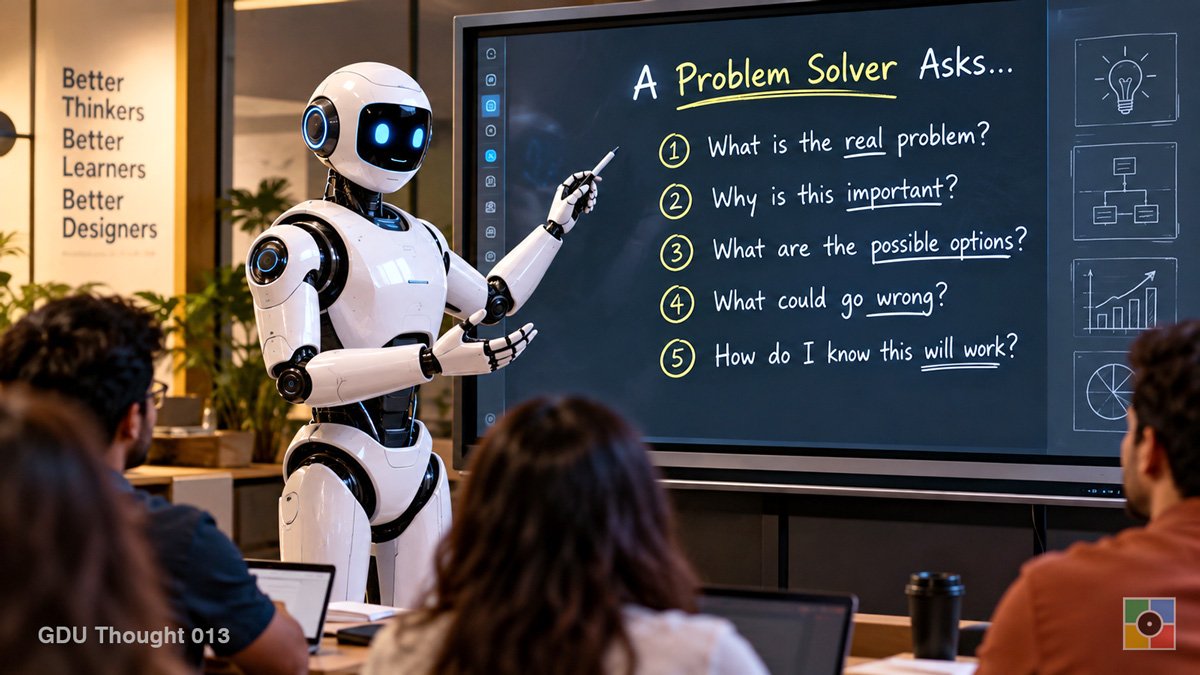
A problem solver asks:
“What is the problem?”
An answer collector asks:
“Which tool should I use?”
A problem solver asks:
“What am I trying to achieve?”
An answer collector asks:
“What should I do?”
A problem solver asks:
“Why should I do it?”
This is the shift we want in education.
Not simply more information.
Not simply more tutorials.
Not simply more software knowledge.
Better thinking.
This Is Why Learning Never Ends
Technology will continue to change.
Software will change.
AI tools will change.
Interfaces will change.
Methods will change.
But curiosity will remain useful.
Observation will remain useful.
Questions will remain useful.
Understanding will remain useful.
Judgment will remain useful.
This is why versionless learning matters.
We should learn principles deeply enough that when technology changes, we can continue learning. ARTEK’s philosophy is built around this idea: technology is temporary, while principles are permanent.
A new tool may require a new button.
But a good question does not require a new version.
One Memorable Quote
The quality of your questions determines the depth of your learning.
Practical Takeaway
The next time you are learning something, do not immediately ask for the answer.
First ask yourself:
What exactly am I trying to understand?
Then ask:
Why?
How?
What if?
Why does this work?
Could there be another way?
And when you use AI, do not use it only to get answers.
Use it to explore your questions.
Challenge its answers.
Ask follow-up questions.
Compare its suggestions with your own understanding.
Then make your own decision.
That is how AI becomes a learning partner instead of a replacement for learning.
One Thought to Remember
The best learners are not always the people who know the most.
They are often the people who are curious enough to keep asking.
They do not stop when they get an answer.
They ask another question.
Then another.
They look deeper.
They observe more carefully.
They challenge what they already know.
They try different possibilities.
They learn from mistakes.
And slowly, something important happens.
They stop becoming answer collectors.
They become thinkers.
So, when you learn something new, don’t ask only:
“What is the answer?”
Ask:
“What is the better question?”
Because a good answer may solve one problem.
But a good question can open a lifetime of learning.
The best learners ask better questions.
And that is why…
Thinking is Unlimited.