
Artificial Intelligence is changing the way we work.
It can write faster.
It can create images.
It can analyze information.
It can generate ideas.
It can even solve many problems.
Because of this, many people are asking an important question:
Will AI replace humans?
Perhaps the better question is:
Which humans will AI replace?
AI Can Replace Some Tasks
Every new technology changes the way people work.
Machines replaced some manual tasks.
Computers replaced many repetitive calculations.
Design software changed how designers create.
And AI is now changing many intellectual tasks.
Some work that once required hours can now be done in minutes.
That is real.
Some tasks will disappear.
Some jobs will change.
New jobs will appear.
But there is something deeper that technology cannot easily replace.
The ability to think.
A Task is Not the Same as Thinking
Imagine a client asks a designer to create a poster.
AI can generate ten poster ideas in seconds.
But should there be ten ideas?
What is the real purpose of the poster?
Who will see it?
What should they notice first?
What information is important?
What should be removed?
What emotion should the design create?
These are not simply production questions.
They are thinking questions.
AI can help produce possibilities.
But someone still has to understand the problem.
Someone has to decide what matters.
Someone has to make the final decision.
Information is Not Understanding
AI can give us an enormous amount of information.
But having information does not automatically mean having understanding.
A beginner may ask AI for a logo and receive hundreds of suggestions.
An experienced designer may ask a completely different question:
What problem should this logo solve?
That difference is important.
The beginner is looking for an answer.
The thinker is trying to understand the problem.
And sometimes, understanding the problem is more valuable than getting the answer.
When AI Gives You More
There is a beautiful line from a Marathi poem by G. D. Madgulkar:
“देणाऱ्याचे हात हजारो, दुबळी माझी झोळी.”
It means, roughly:
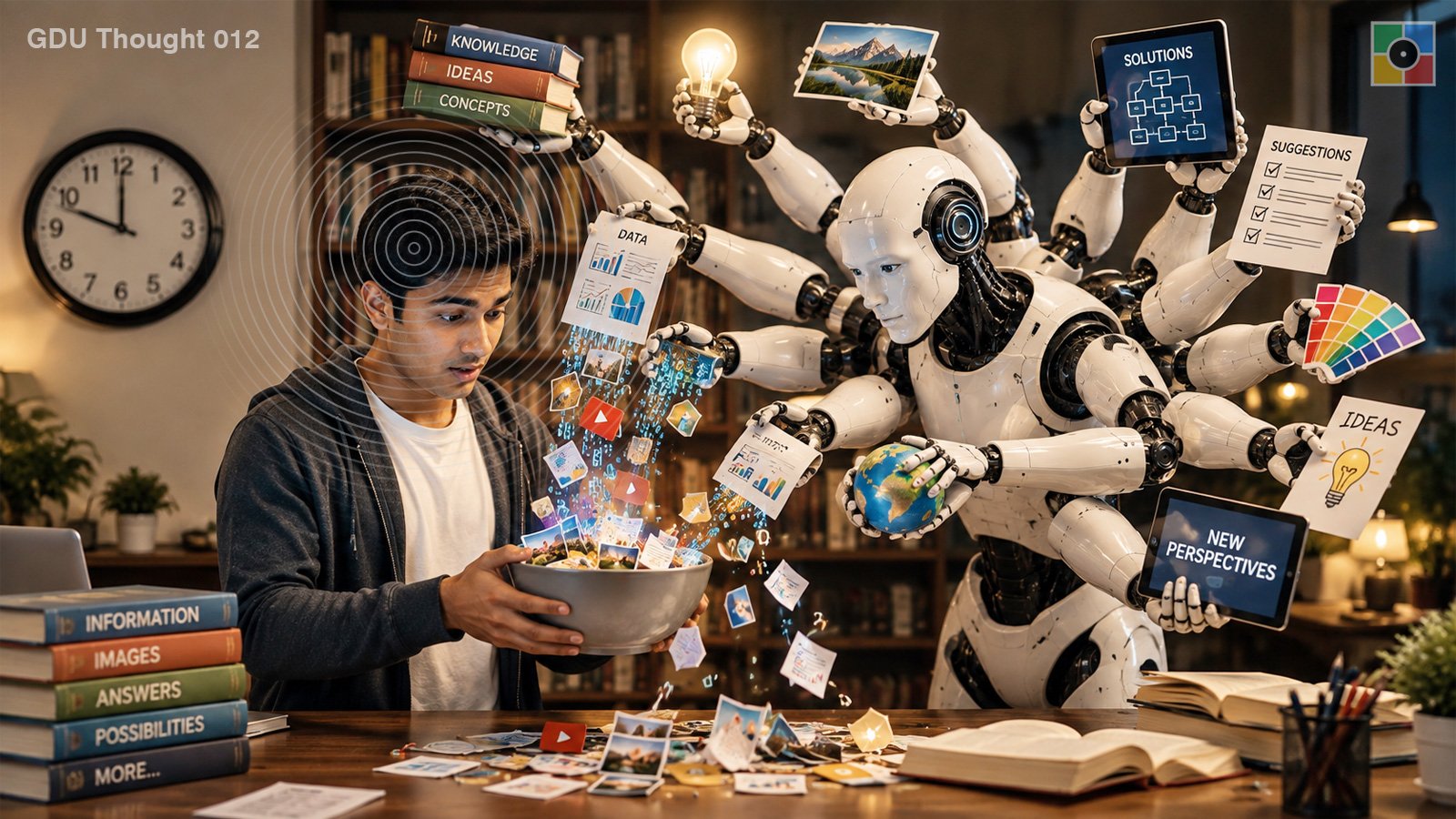
“The giver may have thousands of hands, but my bowl is too small to receive. ”
I think this line has an interesting connection with AI.
Today, AI can give us more than ever before.
More information.
More ideas.
More images.
More suggestions.
More possibilities.
More solutions.
The hands are ready to give.
But is our bowl ready to receive?
Can we understand what we receive?
Can we recognize what is useful?
Can we separate a good idea from an impressive-looking one?
Can we decide what is worth keeping?
Because receiving more information does not automatically mean gaining more understanding.
AI can give us more.
But our understanding decides what we can truly receive.
Better Tools Increase the Value of Better Thinking
This may sound surprising.
But the more powerful our tools become, the more important good thinking becomes.
Why?
Because powerful tools give us more possibilities.
More images.
More ideas.
More variations.
More information.
More solutions.
But more possibilities also mean more decisions.
Someone has to choose.
Someone has to compare.
Someone has to question.
Someone has to reject what looks impressive but does not solve the problem.
That person is the thinker.
Two People Can Use the Same AI
Imagine two designers using exactly the same AI tool.
They have the same model.
The same features.
The same prompts.
The same number of possibilities.
Will they produce the same quality of work?
Not necessarily.
One may understand typography better.
Another may understand the audience better.
One may have stronger visual observation.
Another may have more experience.
One may know what to remove.
Another may know what to keep.
The tool is the same.
The thinking is different.
This is where human capability continues to matter.
What AI Cannot Decide for You
AI can help you ask questions.
It can suggest answers.
It can show possibilities.
It can help you explore.
It can even challenge your ideas.
But there are questions that remain deeply connected to human judgment:
What is important?
What is meaningful?
What is right for this situation?
What should we create?
What should we not create?
And most importantly:
Why are we doing it?
These questions require more than processing power.
They require understanding, experience, purpose and judgment.
This is Why Learning Still Matters
If AI can do more and more work, should we learn less?
Perhaps the opposite is true.
We should learn more deeply.
A designer should understand design.
A photographer should understand photography.
A writer should understand writing.
A business owner should understand the business.
Then AI becomes useful.
Without understanding, we may become dependent on whatever the tool suggests.
With understanding, we can question the tool.
We can correct it.
We can improve it.
We can reject it.
And we can use it in ways the tool itself cannot decide.
The Thinker Becomes More Important
The future may not belong to people who know every AI tool.
It may belong to people who know what to do with powerful tools.
Technology will continue to change.
Today’s AI model will become tomorrow’s old technology.
New tools will appear.
New interfaces will arrive.
New methods will replace old methods.
But the ability to observe, understand, question and decide will remain useful.
That is why ARTEK places thinking before software, understanding before designing, and principles before technology.
One Memorable Quote
AI may replace some tasks.
It will not replace people who know how to think.
Practical Takeaway
The next time you use AI, don’t measure yourself only by how quickly you can create something.
Ask yourself:
Do I understand what I am creating?
Can I explain why it works?
Can I identify what is wrong?
Can I make a better decision?
Can I question the answer AI gives me?
If the answer is yes, you are not simply using AI.
You are thinking with AI.
One Thought to Remember
AI will become more powerful.
It will become faster.
It will become more capable.
It may take over many tasks that humans perform today.
But that does not make human thinking less valuable.
It makes good thinking more valuable.
Because when machines can create thousands of possibilities, the real skill is knowing which possibility deserves to become reality.
So don’t spend all your time trying to become better at using the tool.
Become better at understanding.
Become better at observing.
Become better at questioning.
Become better at deciding.
AI may change the work we do.
But it will not replace the thinker behind the work.
And that is why the future will still need thinkers.
Because thinking is unlimited.