
For many years, education followed a simple formula.
Learn.
Remember.
Repeat.
The more you remembered, the better student you were considered to be.
But today, the world has changed.
Information is no longer difficult to find.
It is available everywhere.
Search engines provide it.
AI explains it.
Videos demonstrate it.
Tutorials are available twenty-four hours a day.
The problem today is not the lack of information.
The problem is knowing what deserves to stay in your mind.
Many Students Are Learning the Wrong Things
Look at how many people learn graphic design today.
They spend hours watching software tutorials.
They memorise shortcuts.
They try to remember every menu.
Every new version brings new features.
Every new AI tool introduces new workflows.
So they start learning again.
And again.
And again.
Technology keeps changing.
Students keep chasing it.
After a few years, many of them feel exhausted.
Not because learning is difficult.
But because they are trying to remember things that were never meant to stay forever.
The Question We Rarely Ask
Whenever a new software or AI tool appears, people immediately ask,
“How do I learn this?”
Very few people stop to ask a more important question.
“What should I learn that will never become outdated?”
That single question changes everything.
Details Change. Principles Do Not.
Every software has its own interface.
Its own tools.
Its own shortcuts.
Its own updates.
CorelDRAW is different from Illustrator.
Photoshop is different from Affinity Photo.
Canva is different from Figma.
Tomorrow, there will be new software.
There will be new AI tools.
Some applications will disappear.
Others will replace them.
But something remains unchanged.
Good composition is still good composition.
Balance is still balance.
Contrast still attracts attention.
Typography still communicates.
Colour still creates emotion.
Visual hierarchy still guides the eye.
These principles existed before computers.
They existed before graphic design software.
They will continue to exist long after today’s software has been forgotten.
That is why principles are permanent.
Technology is temporary.
But There is Something Even More Important
For a long time, I believed that thinking was the most important skill.
Today, I still believe that.
But I also realised something deeper.
Thinking never begins with an empty mind.
It always begins with knowledge.
Imagine someone who has never heard of the Ramayana.
Can that person think about Hanuman?
Can they understand his courage, devotion or strength?
No.
Not because they lack intelligence.
But because they first need knowledge.
Thinking cannot happen about something you do not know.
Knowledge makes thinking possible.
Knowledge is the Invisible Raw Material
Every factory needs raw material.
Without it, nothing can be produced.
The human mind works in exactly the same way.
Knowledge is the raw material of thinking.
Where does that knowledge come from?
From experience.
From observation.
From teachers.
From conversations.
And most importantly…
From reading.
Every good book contains years of someone’s experience, compressed into a few hundred pages.
When you read a book, you are not just collecting information.
You are borrowing another person’s lifetime of learning.
That knowledge becomes part of your own invisible library.
One day, when you face a new challenge, your mind quietly opens that library.
It connects ideas.
It compares experiences.
It discovers patterns.
Then…
Thinking begins.
AI Can Give Information.
Only You Can Build Knowledge.
This is one of the biggest misunderstandings of the AI era.
People believe that if AI can answer every question, they no longer need to learn.
But information is not knowledge.
Knowing where to click is not understanding why.
Knowing a shortcut is not knowing when to use it.
AI can explain a feature.
It cannot build your understanding.
Only learning can do that.
Only experience can do that.
Only reading can do that.
Knowledge cannot simply be downloaded.
It has to be built.
One page.
One observation.
One experience.
One idea at a time.
Why Principles Matter More Than Details
Imagine two students.
The first student spends years memorising software.
The second student spends years understanding design.
Both students are introduced to completely new software.
Who will learn faster?
The answer is obvious.
The student who understands design.
Because software changes.
Principles do not.
A person who understands composition can work in any design application.
A person who understands typography can communicate through any software.
A person who understands colour does not become confused when the interface changes.
Technology may change every year.
Human perception does not.
That is why principles are worth learning for life.
AI Has Changed What We Need to Remember
Twenty years ago, designers had to remember everything.
Tool locations.
Menu commands.
Keyboard shortcuts.
Software techniques.
There was no intelligent assistant available within seconds.
Today, the situation is different.
If you forget a shortcut…
Ask AI.
If you cannot remember an export setting…
Ask AI.
If a tool has moved in the latest version…
Ask AI.
The details are no longer difficult to find.
That changes an important question.
If AI can teach the details…
What should we spend our time learning?
Learn What AI Cannot Build For You
AI can answer questions.
But it cannot replace understanding.
AI can explain a feature.
But it cannot build judgement.
AI can generate options.
But it cannot decide which one is meaningful.
AI can describe a principle.
But it cannot make that principle part of your thinking.
Only you can do that.
Understanding grows slowly.
It grows through observation.
Through reading.
Through practice.
Through mistakes.
Through experience.
That journey cannot be automated.
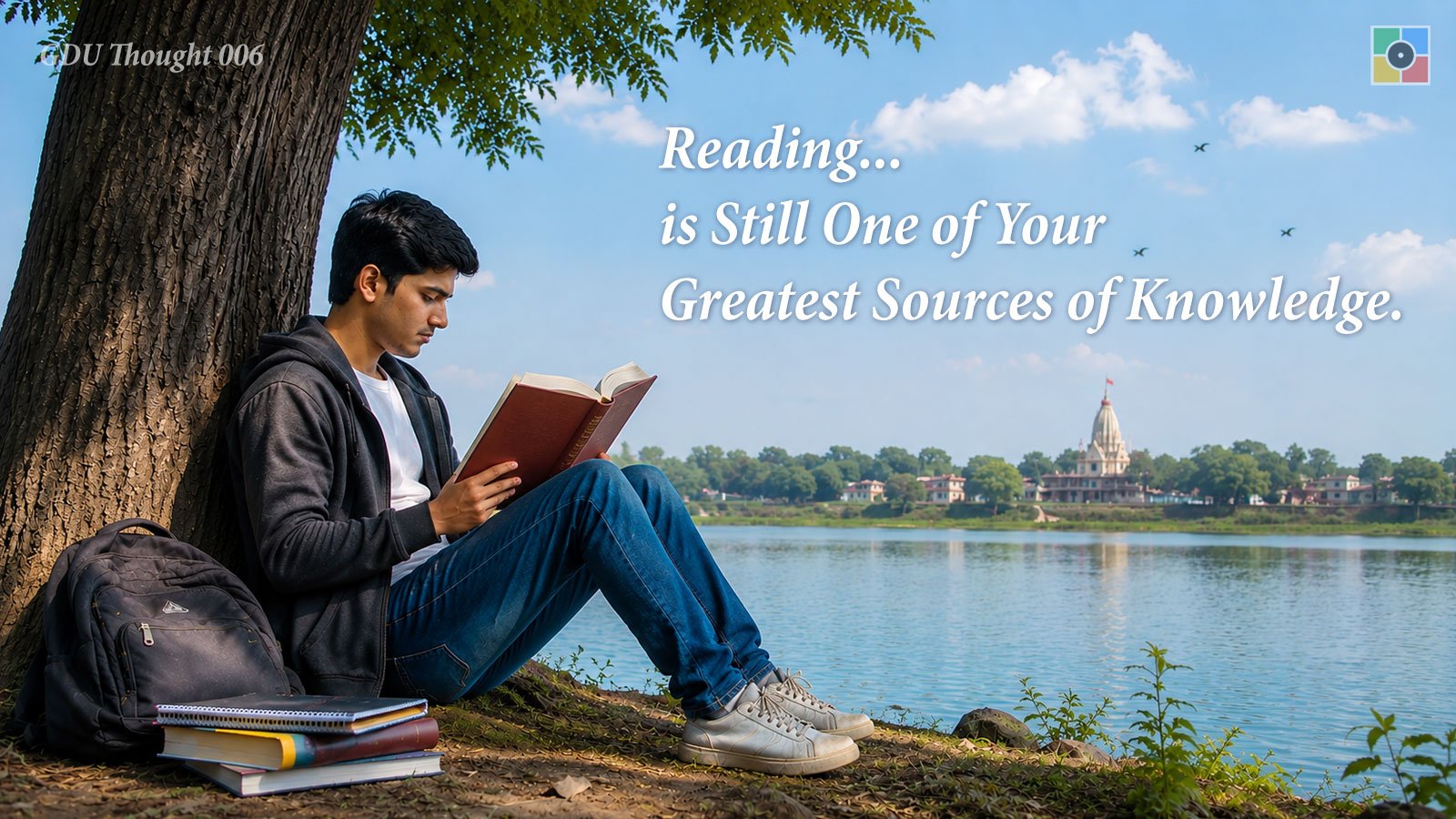
Reading is Still One of Your Greatest Sources of Knowledge.
Some people believe that books are becoming less important because AI can answer questions.
I believe the opposite.
Books are becoming even more valuable.
AI gives answers.
Books build minds.
A book is not simply a collection of information.
It is the author’s years of experience, understanding and thinking, organised into knowledge that another human being can learn from.
Every meaningful book expands your invisible library.
The larger that library becomes…
The richer your thinking becomes.
Good designers do not read only about design.
They read about people.
History.
Psychology.
Business.
Nature.
Communication.
Because every new piece of knowledge becomes future raw material for better thinking.
Build Your Foundation First
Imagine constructing a building.
Would you spend all your time decorating the walls before building the foundation?
Of course not.
Yet many learners do exactly that.
They spend years collecting software tricks.
Very little time building understanding.
Strong foundations create confident learners.
Weak foundations create lifelong dependence on tutorials.
When your principles are clear…
Learning new software becomes easy.
When your knowledge is deep…
Technology becomes an opportunity instead of a threat.
The Future Belongs to Learners, Not Followers
Technology will continue to change.
AI will become smarter.
New software will appear.
Old software will disappear.
But people who understand principles will continue to grow.
Because they are not dependent on tools.
They know how to learn.
And people who know how to learn…
Can learn anything.
Final Thought
Do not spend your life trying to remember every detail.
Build knowledge.
Strengthen your principles.
Develop your thinking.
Then let AI help you with the details whenever you need them.
Technology will continue to evolve.
But a well-trained mind will always stay ahead of technology.
Learn principles.
Let AI teach the details.
One Memorable Quote
“Knowledge makes thinking possible. Principles make thinking meaningful. AI makes learning faster.”
One Thought to Remember
Learn the principles.
Build your understanding.
Let AI teach the details whenever you need them.
That is how you become a designer instead of a software operator.
Thank you for reading this GDU Thought.
If this thought made you think differently, you’ll find many more like this in the GDU Thoughts series.
Because Graphic Design is not just about software or AI.
It is about thinking.
And thinking is unlimited.