
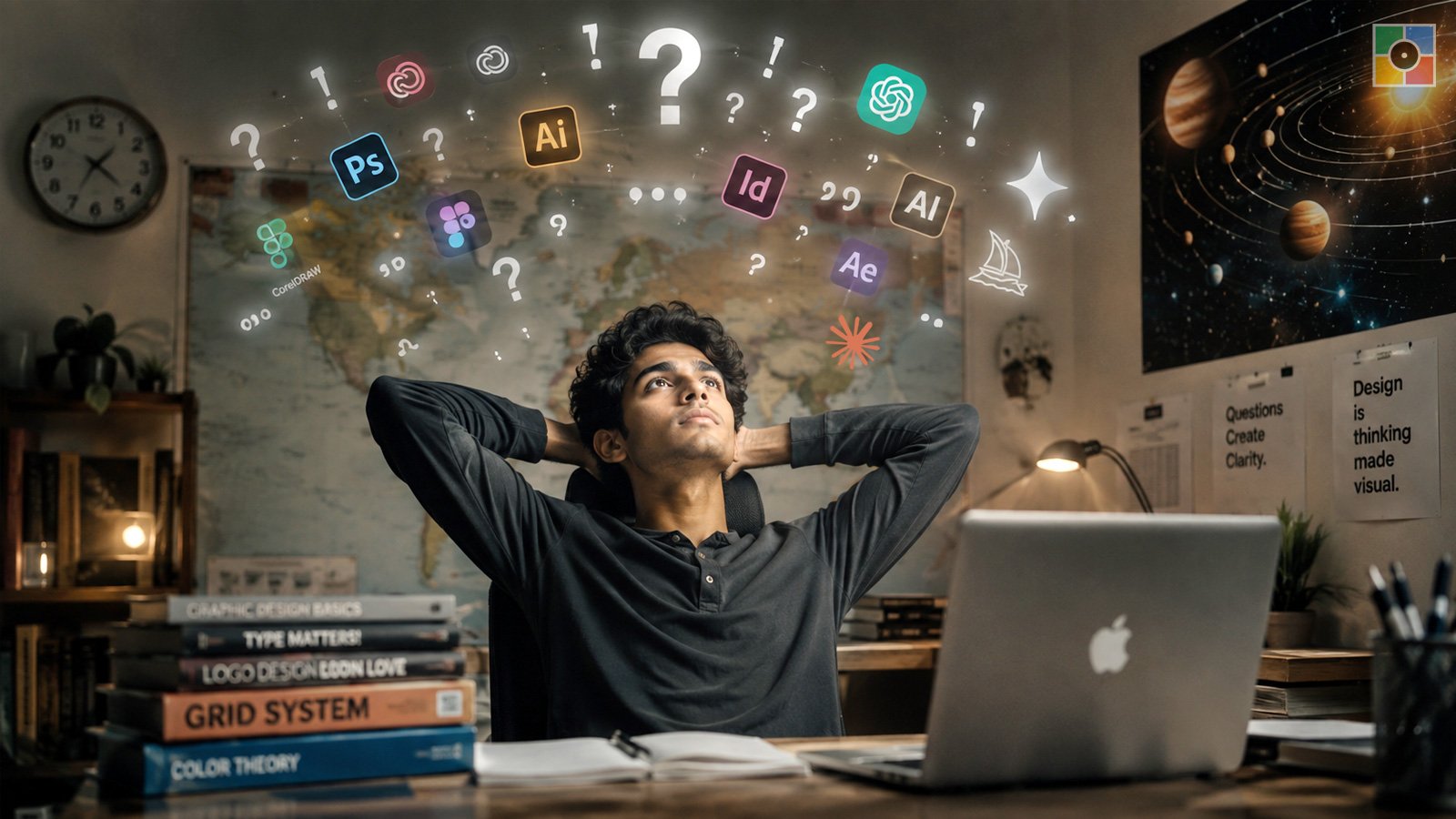
The world is changing faster than ever.
New technology appears.
New software arrives.
New tools become popular.
And now, AI is changing the way we work, create and learn.
Something that was considered a valuable skill a few years ago may become less important tomorrow.
A new tool may replace an old tool.
A new method may replace an old method.
A new technology may change an entire profession.
So, what should we learn?
And more importantly…
How should we learn?
That may be one of the most important questions of our time.
The World Does Not Stop Changing
Imagine someone who learned a software perfectly ten years ago.
At that time, they may have been very good at it.
They knew the menus.
They knew the commands.
They knew the shortcuts.
They knew the workflow.
But technology changed.
The software changed.
The industry changed.
The way people worked changed.
If that person only knew that particular software, their knowledge could slowly become less useful.
But if they knew how to learn, something different happened.
They could learn the new software.
They could understand the new workflow.
They could explore the new technology.
They could adapt.
The tool changed.
But the learner did not become helpless.
Because the real skill was never only the software.
It was the ability to learn.
Learning is Bigger Than Knowing One Thing
We often think of learning as collecting knowledge.
Learn Photoshop.
Learn CorelDRAW.
Learn Illustrator.
Learn WordPress.
Learn video editing.
Learn AI.
Learn social media.
These are useful skills.
But there is something behind all of them.
The ability to learn one new thing after another.
Think about a child learning to ride a bicycle.
The child does not begin by knowing how to balance.
They try.
They lose balance.
They fall.
They try again.
They observe what happened.
They adjust.
They practise.
Slowly, something changes.
The child begins to understand balance.
Nobody can simply transfer that ability into the child’s mind.
The child has to learn it.
That is learning.
And this ability does not disappear when we become adults.
We continue learning throughout life.
Only the subjects change.
In the Past, Learning Was Often About Getting Information
For a long time, information was difficult to find.
You needed a book.
You needed a teacher.
You needed a library.
You needed somebody with experience.
You had to search.
You had to wait.
You had to collect information from different places.
Today, the situation is very different.
Information is everywhere.
Search engines can find it.
Videos can explain it.
Courses can teach it.
And AI can answer questions almost instantly.
This is a wonderful change.
But it creates a new challenge.
When information becomes easy to get…
Knowing what to do with it becomes more important.
You can have access to thousands of answers.
But which answer should you trust?
What should you learn first?
What should you ignore?
What should you practise?
What should you question?
What should you remember?
And what should you understand deeply?
These are learning decisions.
AI Makes Learning Easier. It Does Not Make Learning Automatic.
AI can explain a difficult concept.
It can simplify a subject.
It can give examples.
It can compare ideas.
It can create exercises.
It can give feedback.
It can help you practise.
It can even create a learning plan.
This is an extraordinary advantage.
But there is a difference between having a learning assistant and being a learner.
AI can help you learn.
But you still have to learn.
You still have to pay attention.
You still have to think.
You still have to practise.
You still have to make mistakes.
You still have to ask questions.
And sometimes…
You still have to struggle with something until it becomes clear.
That struggle is not always a problem.
Sometimes, it is part of the learning.
As we discussed in the previous GDU Thought, AI can make information and learning faster.
But understanding has its own speed.
And the same principle applies here.
AI can support your learning journey. It cannot walk the journey for you.
The Difference Between a Student and a Learner
There is an interesting difference between being a student and being a learner.
A student may ask:
“What should I study?”
A learner may ask:
“How can I understand this?”
A student may wait for instructions.
A learner becomes curious.
A student may collect tutorials.
A learner tries things.
A student may be afraid of making mistakes.
A learner uses mistakes as information.
A student may ask:
“Which tool should I learn?”
A learner asks:
“What problem am I trying to solve?”
This difference becomes more important as technology changes.
Because tools will continue to change.
But the ability to learn can stay with you.
A Graphic Designer Has to Keep Learning
Graphic design is a good example.
A designer may begin with print.
Then come websites.
Then social media.
Then video.
Then mobile content.
Then new design tools.
Then AI.
Tomorrow, there will be something else.
Does this mean a designer has to learn everything?
No.
That is impossible.
The real requirement is different.
A designer needs to understand the principles of design.
Then learn the tools needed to apply those principles.
And when the tools change…
Learn again.
This is why ARTEK believes:
Thinking comes before software.
Software is a tool.
Technology is a tool.
AI is also a tool.
The designer’s ability to observe, understand, think and make decisions remains at the centre.
Learn the Principle, Not Just the Procedure
Suppose you learn how to create a particular layout.
You follow ten steps.
You remember every click.
You can reproduce the same layout.
That is useful.
But what happens when the project changes?
The size changes.
The audience changes.
The content changes.
The purpose changes.
The format changes.
Now the ten steps may no longer work.
This is where principles become powerful.
If you understand hierarchy…
You can apply hierarchy in many different layouts.
If you understand contrast…
You can recognise when contrast is needed.
If you understand spacing…
You can make better decisions even in a completely new design.
This is why learning principles is more powerful than memorising procedures.
A procedure may teach you what to do.
A principle helps you understand why to do it.
And once you understand why…
You can learn new ways of doing it.
People Who Know How to Learn Can Start Again
Imagine two people facing a completely new technology.
The first person says:
“I don’t know this.”
And stops.
The second person says:
“I don’t know this yet.”
And starts learning.
That small word…
Yet
changes everything.
“I don’t know this.”
can feel like an ending.
“I don’t know this yet.”
is a beginning.
The second person can search.
Read.
Watch.
Ask.
Experiment.
Practise.
Make mistakes.
Ask better questions.
Try again.
That person does not need to know everything today.
They only need to know how to begin learning.
Curiosity is a Learning Skill
A good learner is not necessarily the person who knows the most.
Sometimes it is the person who asks:
“Why?”
“How?”
“What if?”
“What happens if I change this?”
“Why does this work?”
“Why does this not work?”
“Is there another way?”
Curiosity keeps learning alive.
Without curiosity, learning becomes a task.
With curiosity, learning becomes exploration.
This is especially important in creative fields.
A designer who is curious notices things.
A designer who notices things learns from them.
And a designer who keeps learning keeps growing.
You Do Not Have to Learn Everything
There is another important lesson.
Knowing how to learn does not mean learning everything.
You cannot learn every software.
You cannot follow every AI tool.
You cannot watch every tutorial.
You cannot read every book.
You cannot keep up with every new technology.
And you do not need to.
Learning also means knowing what is worth learning.
That requires judgement.
Ask:
Will this help me solve a real problem?
Will this improve my skill?
Will this deepen my understanding?
Will this remain useful even if the technology changes?
Or am I learning it only because everyone is talking about it?
These questions can save enormous amounts of time.
Stop Chasing Every New Tool
Every few months, something new becomes exciting.
A new AI tool.
A new software feature.
A new design platform.
A new trend.
A new shortcut.
There is nothing wrong with exploring new tools.
But there is a danger.
You can spend all your time learning tools…
and very little time learning your subject.
A graphic designer can keep learning new software and still struggle with typography.
A photographer can buy new equipment and still struggle with composition.
A writer can use AI to generate beautiful sentences and still struggle to communicate an idea.
A designer can use the latest AI image generator and still not understand what the image should communicate.
The tool is not the foundation.
Understanding is the foundation.
Learning How to Learn Creates Independence
This may be one of the biggest advantages of learning how to learn.
You become less dependent.
Suppose you know only one method of doing something.
When that method stops working, you need somebody to show you another method.
But if you understand the subject…
You can search.
You can experiment.
You can compare.
You can ask AI.
You can read documentation.
You can observe other people’s work.
You can find your own solution.
That is independence.
And independence is one of the most valuable outcomes of education.
The goal of education should not be to make a person dependent on a teacher forever.
The goal should be to make the learner capable of continuing without the teacher.
A good teacher does not only give answers.
A good teacher helps the learner become capable of finding answers.
AI Can Become a Powerful Learning Partner
This is where AI becomes especially interesting.
Instead of using AI only to finish work…
Use it to improve your learning.
Ask AI:
“Explain this in simple language.”
“Give me an example.”
“Give me a different example.”
“Why does this work?”
“What mistake am I making?”
“Give me an exercise.”
“Ask me questions to test my understanding.”
“Show me two different approaches.”
“What principle should I learn from this?”
These are very different from simply asking:
“Give me the answer.”
The first approach builds learning.
The second can sometimes replace learning.
The difference is not the technology.
The difference is how you use it.
The Most Valuable Skill May Be Adaptability
Think about the future.
We do not know exactly which software will be popular ten years from now.
We do not know which AI tools will exist.
We do not know which jobs will change.
We do not know which technologies will disappear.
But we can prepare for uncertainty.
How?
By becoming better learners.
A person who can learn a new skill is not limited to the skills they already know.
A person who can understand a new subject can enter unfamiliar territory.
A person who can ask good questions can find better answers.
A person who can think independently can evaluate those answers.
And a person who can keep learning can keep adapting.
That is a powerful combination.
Learning is Not a Phase of Life
Sometimes we think learning belongs to school.
Then college.
Then professional training.
And after that…
Life begins.
But learning does not work like that.
Life itself keeps changing.
So learning has to continue.
You learn from work.
You learn from people.
You learn from mistakes.
You learn from books.
You learn from observation.
You learn from conversations.
You learn from technology.
You learn from teaching others.
You learn from trying something you have never done before.
Every experience can become learning material.
This is one reason experience is so valuable.
A person who keeps learning from life keeps expanding their understanding.
The Future Will Reward Learners
The future may not belong only to the people who know the most today.
Because today’s knowledge can become outdated.
It may belong to people who can learn tomorrow’s knowledge.
That does not mean certificates are useless.
It does not mean expertise is unimportant.
It means that expertise must remain alive.
A person who stops learning may slowly become dependent on yesterday’s knowledge.
A person who keeps learning can continue growing.
This is why lifelong learning is not just a nice idea.
It is becoming a practical necessity.
What Should We Teach the Next Generation?
Perhaps this is an even bigger question.
If AI can answer questions…
Should education focus only on remembering answers?
If AI can explain information…
Should education focus only on collecting information?
If AI can generate examples…
Should education focus only on copying examples?
Maybe we need to teach something deeper.
How to observe.
How to think.
How to ask questions.
How to understand.
How to practise.
How to evaluate information.
How to make decisions.
How to learn independently.
Because these abilities remain useful even when the tools change.
A Simple Learning Cycle
There is a simple cycle that can help.
Observe.
Look carefully.
Ask.
Be curious.
Understand.
Find the principle behind what you see.
Practise.
Try it yourself.
Make mistakes.
Notice what went wrong.
Reflect.
Ask what you learned.
Try again.
Improve.
And then…
Teach.
Explain what you have understood to somebody else.
Then the cycle begins again.
Observe.
Ask.
Understand.
Practise.
Reflect.
Teach.
This is not a software method.
It is not an AI method.
It is a learning method.
And it can remain useful for a lifetime.
The Real Advantage in an AI World
AI is making many things easier.
That is good.
But when everyone has access to powerful tools…
The advantage may shift.
If everyone can generate an image, who decides which image is right?
If everyone can generate text, who knows what should be said?
If everyone can create ten ideas, who can recognise the best one?
If everyone can access information, who can understand it?
If everyone can use AI…
Who can think independently?
That is where human learning becomes even more important.
Technology may increase our speed.
Learning increases our capability.
Final Thought
We do not know exactly what the future will look like.
But we know one thing.
It will change.
Tools will change.
Software will change.
Jobs will change.
Industries will change.
AI will change.
And we will have to change too.
But changing does not have to mean starting from zero every time.
If you know how to learn…
You can begin again.
You can enter a new subject.
You can understand a new tool.
You can ask better questions.
You can practise.
You can make mistakes.
You can improve.
And you can keep moving forward.
That is why the most valuable thing we can learn may not be a particular software, technology or AI tool.
It may be something much more fundamental.
Learn how to learn.
Because the future does not belong only to people who know the answers.
It belongs to people who can keep learning when the questions change.
One Memorable Quote
“Tools will change.
The ability to learn will keep you moving.”
Practical Takeaway
The next time you decide to learn something new, do not ask only:
“What should I learn?”
Also ask:
“How can I learn this well?”
Then:
Observe it.
Ask questions.
Understand the principle.
Practise it.
Make mistakes.
Reflect on them.
Try again.
And when you understand it…
Teach someone else.
You will not only learn the subject.
You will become better at learning.
One Thought to Remember
The future is difficult to predict.
So we cannot prepare for every tool.
We cannot prepare for every software update.
We cannot prepare for every new technology.
But we can prepare ourselves.
We can become curious.
We can become adaptable.
We can become independent learners.
We can learn how to learn.
And that may be one of the most future-proof skills a human being can develop.
The future belongs to people who know how to learn.
Thank you for reading this GDU Thought.
If this thought made you think differently, you’ll find many more like this in the GDU Thoughts series.
Because Graphic Design is not just about software or AI.
It is about thinking.
And thinking is unlimited.